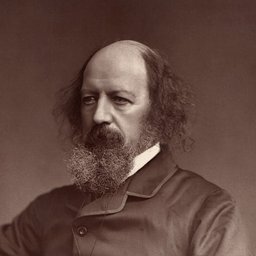
Victorian poet laureate whose lyric music, Arthurian imagination, and meditations on grief and faith made him one of the central poets of nineteenth-century English literature.
Early Life and Formation
Alfred, Lord Tennyson was born in 1809 in Lincolnshire and grew up within a large clerical family whose intellectual ambition was matched by emotional strain.
He was educated first at home and later at Trinity College, Cambridge, where he entered the circle later known as the Apostles and formed a decisive friendship with Arthur Henry Hallam. The early poems already show the hallmarks that would remain with him: an ear for cadence, a taste for legend and dream, and a gift for making mood audible in the line.
From the beginning Tennyson wrote as a poet intensely aware of voice. He could sound private without losing grandeur, musical without becoming vague, and public without ceasing to be inward.
Grief, Doubt, and Major Poems
The death of Hallam in 1833 shaped Tennyson's mature career and gave rise, over many years, to In Memoriam A.H.H., one of the great long elegies in English.
That poem is central to understanding him. It is not only an expression of mourning, but a sustained argument with faith, scientific change, memory, and the fear that love may not survive loss. Tennyson's poetry often stages that Victorian tension between religious inheritance and modern uncertainty without reducing it to a neat resolution.
Alongside the elegiac work stand the dramatic monologues and lyrical set pieces that made him famous: "Ulysses," "Tithonus," "The Lady of Shalott," and many others. These poems show how expertly he could give speech to desire, weariness, aspiration, erotic isolation, or historical imagination.
Public Role and Arthurian Vision
Tennyson became poet laureate in 1850, the same year he married Emily Sellwood, and he increasingly occupied a visible public position in British literary life.
That public authority did not flatten his art. Instead it expanded its range. In works such as Idylls of the King, he used the Arthurian legends to think about leadership, idealism, sexual betrayal, national destiny, and the fragility of moral order. He could turn myth into a language for contemporary unease.
Even when writing occasional or national verse, Tennyson remained above all a poet of atmosphere and pressure. He understood how an image, repeated sound, or recurring phrase could hold together emotion and thought.
Style and Legacy
Tennyson matters because he joined technical finish to emotional intelligence with unusual consistency over a very long career.
His music is immediately recognizable, but his best work is not merely mellifluous. Beneath the polish lies real tension: between longing and resignation, duty and desire, heroism and exhaustion, faith and skepticism. He remains one of the poets most capable of giving dignified form to uncertainty.
For readers of public-domain poetry, Tennyson offers both entry and depth. He is a poet of memorable surfaces, but also of serious rereading, where the beauty of the line keeps opening onto doubt, loss, historical change, and the strange persistence of aspiration.
Discover the best poems by Alfred, Lord Tennyson on The Poet's Place. Read the greatest, most popular, and trending poetry by Alfred, Lord Tennyson. From beautiful and inspiring verses to famous, timeless classics — explore the most loved and iconic Alfred, Lord Tennyson poems for free.