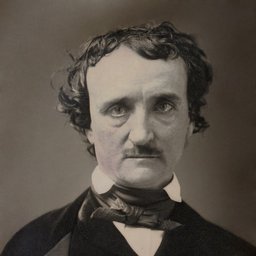
American poet, critic, and storyteller whose musical language, gothic intensity, and theories of poetic effect reshaped modern literature.
Life and Literary Career
Edgar Allan Poe was born in 1809 and lived a brief, unstable, and extraordinarily influential literary life marked by financial hardship, editorial labor, and recurring personal loss.
He worked as a magazine writer and critic in several cities, helping define the culture of periodical literature in the United States. That editorial existence mattered. Poe was not writing from leisure; he was writing inside a fast, competitive print world that sharpened his sense of style, compression, audience, and literary effect.
The result is a body of work that feels intensely crafted. Poe's poems and tales are rarely accidental in their movement. He thought hard about how a composition should strike the reader, how mood should accumulate, and how unity of impression could give even short works unusual force.
Poetry and the Art of Effect
Poe's poetry is inseparable from his sense that sound, repetition, refrain, and tonal pressure could generate a near-hypnotic intensity.
Poems such as "The Raven," "Annabel Lee," and "Ulalume" are often remembered for atmosphere, but they are also technical performances in pacing and recurrence. Poe understood that a poem could think through pattern as much as through argument. His best-known lyrics create an emotional chamber in which grief, obsession, beauty, and dread keep echoing back upon themselves.
He also wrote criticism and poetics that helped shape later understandings of lyric concentration. Even readers who disagree with his theories feel their consequences in the work itself: a preference for compression, a refusal of slackness, and a deep investment in emotional and auditory design.
Darkness, Beauty, and Modern Sensibility
Poe is often reduced to gloom, but what makes him last is not darkness alone. It is the strange elegance with which he binds darkness to beauty, intellect, and formal control.
Loss, burial, doubling, premature mourning, unstable perception, and psychological extremity all recur in his writing, yet they do so through highly shaped language. That fusion of morbidity and precision is one reason he became so important to symbolists, decadents, modern short-fiction writers, and later poets interested in musicality and obsession.
He was also a cosmopolitan influence. Poe was read, translated, and transformed far beyond the United States, especially in France, where his reputation became decisive for later literary movements.
Legacy
Poe remains central because he changed what readers thought short literary forms could do.
He expanded the possibilities of the lyric of mourning, the gothic tale, the analytic story, and the prose sketch of extreme consciousness. His work still feels modern in its self-awareness, its theatrical intelligence, and its trust in atmosphere as a serious mode of thought.
For public-domain readers, Poe offers a rare combination: immediate recognizability and continuing strangeness. The famous pieces endure, but the enduring power comes from how rigorously he shaped voice, rhythm, and emotional pressure into forms that still unsettle and attract.
Discover the best poems by Edgar Allan Poe on The Poet's Place. Read the greatest, most popular, and trending poetry by Edgar Allan Poe. From beautiful and inspiring verses to famous, timeless classics — explore the most loved and iconic Edgar Allan Poe poems for free.