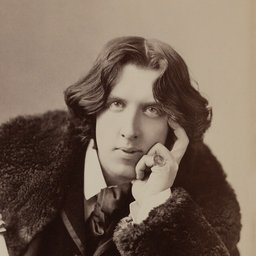
Irish poet and playwright whose verbal brilliance, aesthetic daring, and later prison writing gave his poetry both decorative splendor and moral depth.
Formation and Public Persona
Oscar Wilde was born in Dublin in 1854 and educated at Trinity College Dublin and Oxford, where he developed the intellectual polish and aesthetic conviction that would make him one of the most recognizable literary personalities of his age.
He emerged not simply as a writer, but as a public figure who understood style itself as a cultural performance. That performative intelligence shaped his poetry as well as his criticism and drama. Wilde knew how to turn wit, pose, and ornament into instruments of seriousness rather than excuses for triviality.
His early verse shows his apprenticeship to classical and aesthetic traditions, but even there one senses the theatrical self-awareness that would define his mature voice.
Poetry, Beauty, and Artifice
Wilde's poetry is often associated with lush description, decorative surface, and cultivated artifice, yet its best effects depend on more than ornamental beauty.
He writes through masks, allusions, and stylized poses, but these are not empty veneers. They are ways of examining longing, performance, cruelty, cultural memory, and the instability of identity. Wilde's relation to beauty is always more dynamic than a slogan about aestheticism suggests.
Readers who know him mainly through the plays are often surprised by how much tonal range the poems contain: lushness, satire, tenderness, pageantry, irony, and eventually stark moral gravity.
Trial, Prison, and Aftermath
The catastrophic trials and imprisonment of the 1890s transformed Wilde's life and deeply altered the emotional register of his later writing.
The Ballad of Reading Gaol, in particular, shows what happens when Wilde's formal gift meets direct suffering, institutional violence, pity, and self-knowledge. The poem's power lies in its clarity. The brilliant stylist becomes a writer of public sorrow without losing rhythmic command.
That late gravity does not cancel the earlier artifice; it reframes it. Wilde's career becomes one of the clearest examples in modern literature of how performance and pain can exist in the same artistic identity.
Legacy
Oscar Wilde endures because he brought exceptional verbal intelligence to questions of beauty, morality, theatricality, and social punishment.
He remains a central figure not only for his epigrams and dramatic comedies, but for the way his poetry traces a path from cultivated surface to wounded clarity. He understood that style can reveal as much as it conceals.
For public-domain readers, Wilde offers a body of work where elegance and suffering, artifice and candor, can be read together rather than opposed.
Discover the best poems by Oscar Wilde on The Poet's Place. Read the greatest, most popular, and trending poetry by Oscar Wilde. From beautiful and inspiring verses to famous, timeless classics — explore the most loved and iconic Oscar Wilde poems for free.