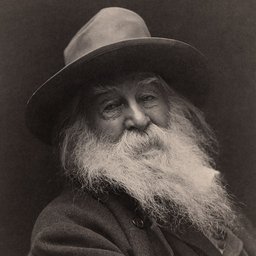
American poet of democracy, embodiment, and expansive free verse whose Leaves of Grass transformed the scale and cadence of modern poetry.
Self-Making and Leaves of Grass
Walt Whitman was born in 1819 on Long Island and worked in printing, journalism, teaching, and editing before reinventing himself as the poet of Leaves of Grass.
That self-invention is one of the central facts of his career. Whitman did not simply publish a book; he built an authorial presence through repeated revisions, expansions, and re-presentations of the same lifelong project. Leaves of Grass became a changing organism that grew with his sense of what American poetry might be.
Whitman's radical wager was that the speaking self of poetry could be capacious enough to hold body, labor, city, sexuality, comradeship, nation, and cosmos together in one democratic field of address.
Voice, Body, and Democracy
Whitman's free verse and cataloguing rhythms altered the possibilities of poetic line in English.
He could move by accumulation rather than strict closure, by parallelism rather than inherited metrical regularity, and by a speaking cadence large enough to include many classes of experience. The famous Whitmanian "I" is not merely autobiographical; it is an instrument for imagining relation, inclusion, and collective life.
Body and spirit in Whitman are never enemies. He writes desire, touch, labor, illness, and mortality with a frankness that remains startling. His poetry insists that embodiment is one of the places where democracy becomes real.
War, Compassion, and Late Work
The American Civil War deepened Whitman's work profoundly.
His service in hospitals and his close attention to wounded bodies changed the tone of his poetry, introducing new registers of grief, tenderness, and national sorrow. The Whitman of Drum-Taps and later poems is still expansive, but he has been tested by pain and historical catastrophe in ways the earliest celebratory poems only anticipate.
This widening of emotional range is one reason Whitman lasts beyond the slogans often attached to him. He is not only a poet of confidence; he is also a poet of care, damage, and the cost of collective life.
Legacy
Whitman matters because he reimagined poetic voice on a scale few writers have matched.
Modern free verse, queer poetics, democratic poetics, documentary poetics, and many later experiments in literary selfhood all bear his influence. Yet he remains readable not merely as origin, but as living presence: exuberant, contradictory, intimate, and open.
For public-domain readers, Whitman offers one of poetry's largest invitations. He asks the reader not only to admire a poem, but to enter a field of relation where self and multitude, flesh and thought, can be spoken together.
Discover the best poems by Walt Whitman on The Poet's Place. Read the greatest, most popular, and trending poetry by Walt Whitman. From beautiful and inspiring verses to famous, timeless classics — explore the most loved and iconic Walt Whitman poems for free.