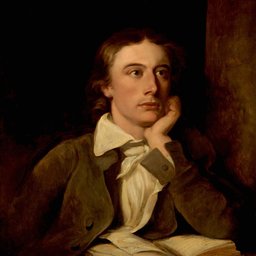
English Romantic poet whose odes, sensual language, and reflections on beauty, mortality, and imagination became central to lyric poetry.
Short Life, Rapid Development
John Keats was born in 1795 and died in 1821, yet in little more than half a decade he produced one of the most remarkable poetic careers in English.
Originally trained in medicine, he moved into literary life through friendship, reading, and an increasingly urgent commitment to poetry. What makes Keats extraordinary is not only the brilliance of the late poems, but the speed and seriousness of his development. He kept testing what a poem could hold: sensuous delight, philosophical pressure, mortal fear, and negative capability all at once.
His letters are crucial to this growth. They reveal a poet thinking intensely about imagination, uncertainty, receptivity, and the relation between suffering and artistic form.
The Great Odes
Keats is often encountered through the major odes, and with good reason: they are among the supreme achievements of lyric meditation in English.
"Ode to a Nightingale," "Ode on a Grecian Urn," "To Autumn," and their companion poems turn moments of sensation into profound acts of thought. Keats can begin from a bird, an urn, a season, or a mood and arrive at questions of transience, art, desire, and consciousness without losing the richness of physical detail.
His poetry is often called sensuous, but the term matters only if it includes intellect. Keats's attention to touch, fragrance, ripeness, color, and sound is inseparable from an awareness that beauty is shadowed by finitude.
Beauty, Vulnerability, and Imagination
Keats's poetry is full of delight, but it is never protected from vulnerability.
Illness, failure, social insecurity, and the knowledge of mortality accompany the poems at every stage. What is distinctive is the way Keats refuses to turn difficulty into mere bitterness. He keeps asking how the imagination can remain open to fullness while fully aware of loss.
This is part of why the poems continue to feel young without feeling immature. They are intensely alive to sensation and equally alive to disappearance.
Legacy
Keats matters because he joined verbal richness to philosophical openness with uncommon grace.
Later poets, critics, and readers have returned to him for his sense of tact, his musical line, his speculative generosity, and his refusal to force experience into premature certainty. He remains one of the finest poets of ripeness under pressure.
For public-domain readers, Keats offers an ideal meeting point of beauty and difficulty: poems that are immediately pleasurable and endlessly deepened by rereading.
Discover the best poems by John Keats on The Poet's Place. Read the greatest, most popular, and trending poetry by John Keats. From beautiful and inspiring verses to famous, timeless classics — explore the most loved and iconic John Keats poems for free.