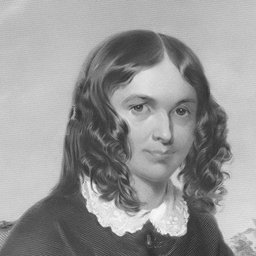
English poet of passion, intellect, and moral seriousness whose work joins lyric intimacy to political conscience and expansive narrative ambition.
Early Life and Literary Emergence
Elizabeth Barrett Browning was born in 1806 and became known as a precocious writer long before her marriage made her half of one of literature's most famous poetic partnerships.
Chronic illness, family control, and an intense reading life shaped her early years, but they did not confine the scope of her work. From the beginning she read widely in classical and modern literature and wrote with unusual authority on questions of form, feeling, religion, and justice.
Her poetry is distinguished by a rare combination of learned density and emotional urgency. She could sound ardent, argumentative, prophetic, and intimate within the space of a single poem.
Love, Italy, and Major Works
Her courtship and marriage with Robert Browning, followed by their life in Italy, transformed both her biography and the public imagination surrounding her work.
Sonnets from the Portuguese remains one of the great love sequences in English not because it idealizes feeling, but because it records the movement from hesitation and wounded self-estimate toward trust and devotion. The sonnets feel earned. Their intimacy is inseparable from intelligence.
At the same time, Barrett Browning worked on a much larger scale. Aurora Leigh, her verse-novel about vocation, gender, art, labor, and modern society, shows the breadth of her ambition. She was never only a lyric poet; she was a major architect of long poetic forms as well.
Political Imagination
Barrett Browning's poetry is also marked by ethical and political seriousness, especially in relation to slavery, child labor, nationalism, and public suffering.
She wrote with conviction about injustice without collapsing poetry into rhetoric. What gives the political poems their force is that she understood public questions as matters of feeling, conscience, and language as much as of policy. She wanted poetry to remain art while still answering the world.
That breadth helps explain her appeal across generations. She speaks not only to readers seeking lyric feeling, but also to readers interested in how poetry can address history, social violence, and moral responsibility.
Legacy
Elizabeth Barrett Browning remains one of the indispensable nineteenth-century poets because she united seriousness of mind with genuine warmth of voice.
She is a poet of love, but never merely of sentiment; a poet of public conviction, but never merely of declaration. Her work continues to matter because it insists that thought and feeling deepen one another when the writing is strong enough to hold them together.
For readers returning to public-domain poetry, she offers extraordinary range: sonnets of inward transformation, long works of social and artistic ambition, and a voice at once high-minded, vulnerable, and intensely alive.
Discover the best poems by Elizabeth Barrett Browning on The Poet's Place. Read the greatest, most popular, and trending poetry by Elizabeth Barrett Browning. From beautiful and inspiring verses to famous, timeless classics — explore the most loved and iconic Elizabeth Barrett Browning poems for free.