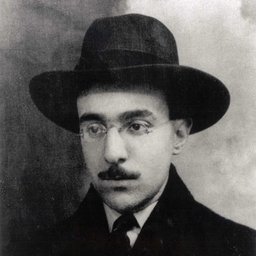
Portuguese modernist poet whose work ranges from intimate lyric reflection to philosophical restlessness and an extraordinary system of literary personas.
Life Between Languages
Fernando Pessoa was born in Lisbon in 1888 and spent crucial childhood and adolescent years in Durban, South Africa, where he received an English-language education that permanently shaped his literary ear.
That bilingual and bicultural formation is central to understanding him. Pessoa could move between Portuguese and English not simply as a translator of meanings, but as a writer alert to the different pressures, tonalities, and intellectual habits of each literary language. His work belongs deeply to Portuguese modernism, but it also bears the mark of cosmopolitan reading and self-division from the start.
He lived much of his adult life in Lisbon, working in commercial offices, translating correspondence, writing criticism, planning magazines, and composing an enormous body of poems, prose fragments, reflections, sketches, and unfinished projects that far exceeded what appeared in book form during his lifetime.
Poetry, Masks, and Multiplicity
Pessoa's most radical contribution to modern literature is the heteronymic system through which he turned authorship itself into a dramatic field.
These figures are not mere pen names. Alberto Caeiro, Ricardo Reis, Álvaro de Campos, Bernardo Soares, and other personae possess distinct styles, temperaments, philosophical postures, and imagined biographies. They write not as masks over a stable self, but as alternative centers of consciousness that complicate the idea of a single authorial identity.
Through them Pessoa made inward multiplicity formally productive. He transformed doubt, division, theatricality, and self-observation into literary method, creating a body of work in which personality becomes a medium rather than a fixed possession.
Work Under His Own Name
Pessoa's writing under his own name remains indispensable in its own right, especially for the way it brings together lyric inwardness, philosophical unease, and reflections on national destiny.
Mensagem, the only Portuguese book he published in his lifetime, gives emblematic form to Portuguese history and myth while still bearing his characteristic tension between vocation and uncertainty. Elsewhere, his poems and prose fragments return to boredom, dreaming, destiny, esoteric speculation, and the instability of the self with tireless inventiveness.
He is both a poet of grand metaphysical hunger and a poet of everyday alienation, of abstract speculation and minute emotional weather. Few writers can move so freely between these registers without losing authority.
Posthumous Presence and Legacy
Pessoa died in 1935, leaving behind the famous trunk of manuscripts that made clear the full scale of his unfinished and dispersed literary world.
That posthumous archive changed his reputation from important poet to one of the indispensable writers of modern literature. Readers and scholars continue to encounter new arrangements of the work because so much of it existed in fragments, projects, notes, and competing authorial signatures rather than in fixed final books.
He endures because he speaks to problems that feel increasingly modern: fractured identity, performed selfhood, urban estrangement, philosophical restlessness, and the desire to become plural without disappearing. In public-domain poetry, few figures are more intellectually provocative or more emotionally inexhaustible.
Discover the best poems by Fernando Pessoa on The Poet's Place. Read the greatest, most popular, and trending poetry by Fernando Pessoa. From beautiful and inspiring verses to famous, timeless classics — explore the most loved and iconic Fernando Pessoa poems for free.