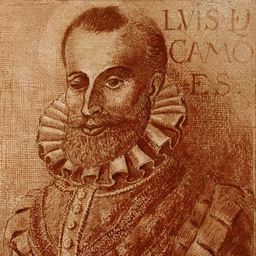
Portugal's national poet, celebrated for The Lusiads and for lyrics that unite classical form, amorous intensity, exile, and reflective melancholy.
Poet of Empire and Exile
Luís Vaz de Camões, born in the sixteenth century, occupies a singular place in Portuguese literature as both national poet and deeply personal lyric voice.
The outlines of his life carry the marks of travel, military service, hardship, and long association with the Portuguese imperial world. That biographical horizon matters, but Camões is more than a historical emblem. He is a writer who can move from epic scale to intimate lyric compression without losing force.
His work joins Renaissance humanism, classical inheritance, and a sharp awareness of fortune, absence, and instability. He writes from within a world of expansion while remaining acutely alert to loss.
The Lusiads and National Imagination
Camões is inseparable from Os Lusíadas, the great Portuguese epic that narrates Vasco da Gama's voyage while framing Portugal's history within a classical and heroic structure.
The poem matters not only as patriotic monument, but as a feat of literary architecture. Camões uses epic form to connect navigation, empire, memory, myth, and political aspiration. He writes with grandeur, but he is not blind to cost, danger, and reversal.
That complexity is part of why the poem remains alive. It is at once an act of celebration and a meditation on destiny, fame, and the burden of historical ambition.
Lyric Poetry and the Language of Longing
Alongside the epic stands a lyric body of sonnets, songs, and redondilhas that has been central to Portuguese literary memory for centuries.
Here Camões becomes a poet of desire, absence, mutability, and reflection. His love poems often turn on paradox, on the way longing sharpens thought and suffering reveals the instability of all worldly goods. The language is elegant, but never cold. He remains one of the great lyric anatomists of contradiction.
These poems help explain why Camões cannot be reduced to national symbolism alone. He is also a poet of inward struggle, of remembered beauty, and of intelligence deepened by affliction.
Legacy
Camões matters because he stands at the meeting point of cultural monument and living poetic craft.
He gave Portugal its great epic, but he also left lyrics of such refinement and intensity that later generations continued to hear in them the pressures of love, exile, and historical consciousness. Few poets command both public and private registers so securely.
For readers of public-domain poetry, Camões offers a rare amplitude: epic imagination, courtly eloquence, philosophical melancholy, and lyric directness all within one career.
Discover the best poems by Luís Vaz de Camões on The Poet's Place. Read the greatest, most popular, and trending poetry by Luís Vaz de Camões. From beautiful and inspiring verses to famous, timeless classics — explore the most loved and iconic Luís Vaz de Camões poems for free.